About
El Zein, H. & Rhéa Kahale, R.: First comprehensive IUCN Red List assessment of 100 endemic species of the flora of Lebanon. — Fl. Medit. 32: 327-338. 2022. — ISSN: 1120-4052 printed, 2240-4538 online.
Abstract
This review presents the first IUCN Red List of 100 vascular plant species endemic to Lebanon. The taxa were assessed using the IUCN guidelines and criteria to evaluate their conservation status. Assessed taxa are either endemic to the coast of Lebanon, the Beqaa, the mountain ranges of Mount Lebanon, Anti-Lebanon and Mount Hermon. Most of the species assessed were in the Endangered category (54), followed by the Vulnerable (20), Critically Endangered (16), Least Concern (7), Near Threatened (2) and Data deficient (1). The rarity of these endemic taxa was illustrated by the fact that 29% had an AOO inferior or equal to 20 km². Unregulated urbanisation, road construction, quarries, forest fires and overgrazing constituted the main causes for the decrease of many endemic species. Most of the threatened taxa occurred in rocky habitats, woodlands and shrublands of the supra (20), montane (36), oro-Mediterranean (28) belts. Around 81% and 70% of the taxa respectively listed as CR and EN were located in the montane and oro-Mediterranean belts. Only 2 taxa occurred in coastal habitats and only 8 were related to wetlands. Thirty-five of the threatened taxa were included in at least one protected area, while 17 were present in two protected areas. Mount Hermon hosted 17 threatened taxa, followed by Horsh Ehden (9), Jabal Moussa (8), Chouf Biosphere (7), Tannourine (6), Ehmej el-Dichar (3), Ras Chaqaa (1) and Yammoune (1). The distribution of the threatened taxa within protected areas highlighted the fact that some habitats are underrepresented in the network of natural reserves in Lebanon. High plateaus of the oroMediterranean belt over 2000 m were the less protected habitats. The regions of Mounts Makmel, Mneitre, Sannine and Kneisse particularly lacked protection, as well Anti-Lebanon range. These areas should be targeted in priority for conservation actions such as the creation of protected areas. Due to the limited size of the country and its high density in human population, most of the threats are widespread but vary depending on the altitudinal belt.
Photos (1)
Related Publications
Setting conservation priorities for Lebanese flora—Identification of important plant areas
Decline of endemic Oncocyclus irises (Iridaceae) of Lebanon: survey and conservation needs
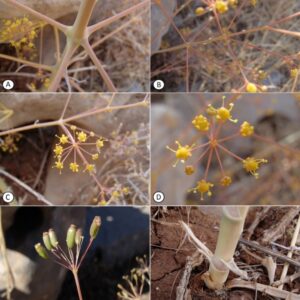
Newly recorded for the vascular flora of Lebanon: Ferula biverticellata J
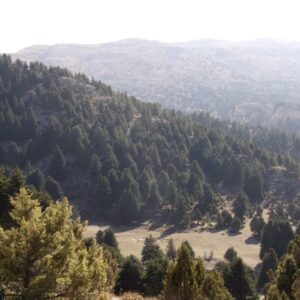
Important Plant Areas in Lebanon